From DORA to HX CARE
HX, the Human Experience framework, is a successor to DORA, SPACE, and DX Core 4. It's built for organizations where humans and AI agents ship together. A key part of the framework, the HX CARE model covers how agentic work sessionsAn agentic work session is the transcript of working with an AI agent — the prompts, the replies, the tool runs, the decisions. The tools people already use write these files as they work; PSF is the open format that keeps them portable. Click through for PSF., where humans do the work, can be used to learn from and improve the way we work.
Past frameworks used what they could
DORA read pipelines, SPACE added surveys, and DX Core 4 unified them. All three were designed before agents changed how software gets built, so none of them can see that change.
“Is our software delivery healthy?”
The four keys, read from pipeline telemetry, and evidence that speed and stability go together.
“What is developer productivity, really?”
Five dimensions, and permission to treat how work feels as data.
“Can this be one deployable standard?”
DORA, SPACE, and DevEx unified into a benchmarkable four.
“How is work with AI actually going?”
Reads the sessions themselves, with the author in control of sharing.
Your engineers produce two codebases. You keep one.
Alongside the code, every engineer now produces a second body of work: their sessions with AI agents — the requirements clarified, the alternatives weighed, the reasoning that became the code. It is work product, created in your repositories, for your product. And today it mostly lives in local folders on personal laptops.
Source code has been treated as intellectual property for as long as it has been worth paying for. The reasoning that produces it deserves the same care, and it is an unusually rich record of how your organization actually works.
Measure where work happens
For a decade, “how we work” was analyzed in one system while the work happened in another. Findings traveled by export and quarterly deck, and most were stale before anyone could act on them.
Findings crossed systems by integration and slideware. Action was always a meeting away, and the context was gone by the time anyone acted.
When the platform that runs the work also reads it, findings return to the next working session while the context is still warm.
That loop compounds. Take two organizations that adopt AI in the same quarter, where one reads its own record and one leaves it on laptops. A year later the gap between them has little to do with talent or headcount. One of them was improving a little every week, and the other wasn't.
Kept by the organization. Shared only by you.
The organization stores and protects the record, the way it stores code. Reading it is a separate matter: a raw session opens to its author, and reaches a team only when the author shares it — under safeguards everyone can see.
The record
Kept by the organization — preserved, backed up, never lost to a laptop or network failure.
Reading
A raw session opens to its author. Sharing it further is the author's decision.
Team views
Numbers above the individual describe teams. The only person who sees a number about you is you.
Answers
Raise a problem and something visible comes back — a change, a decision, or a clear no with the reason.
Open source keeps the record, end to end
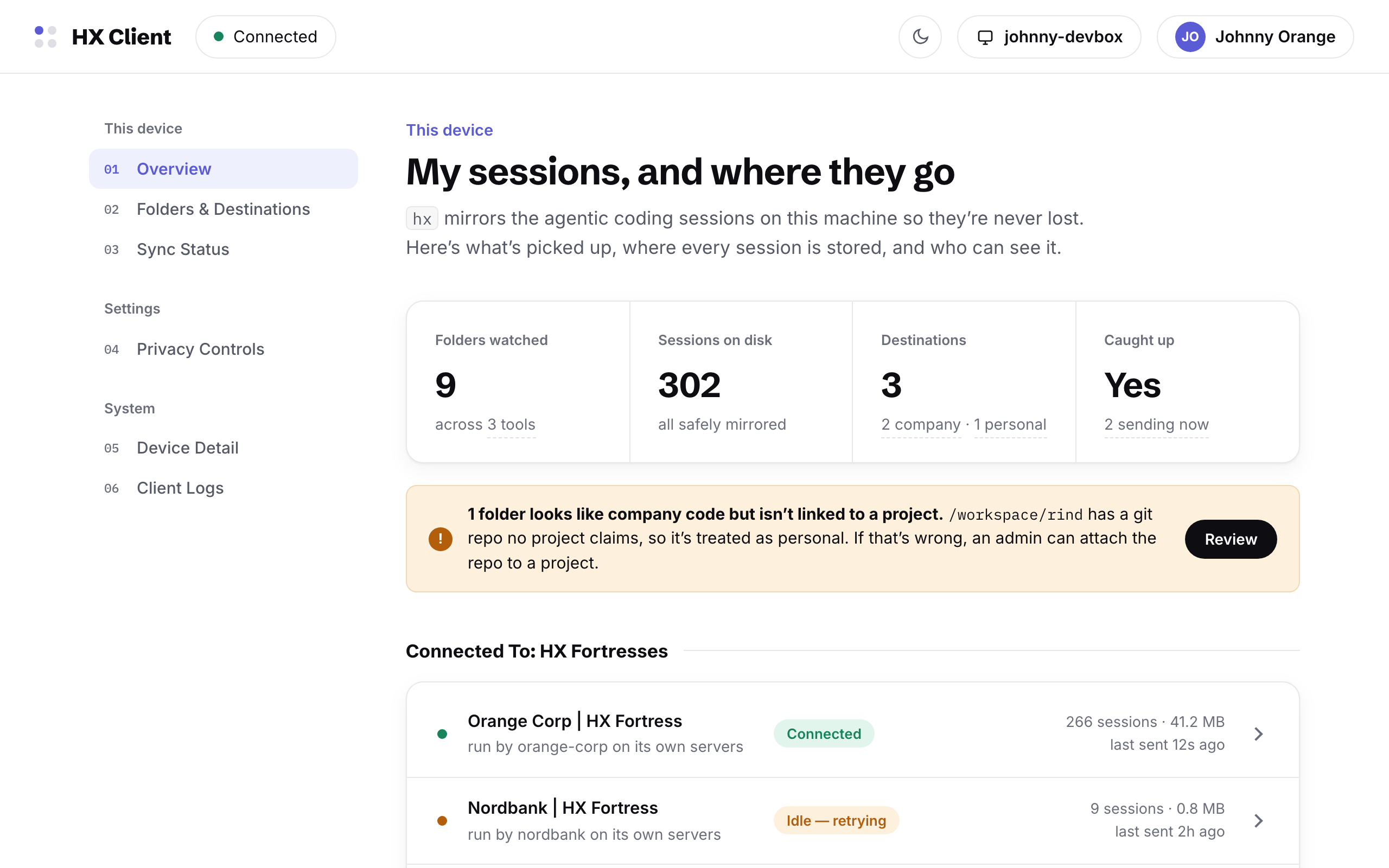
A small daemon, hx, mirrors sessions from each device to storage the organization runs itself — with a local interface where the author sees every folder, every destination, and every byte in flight. The server half is HX Fortress: one service on the organization's own infrastructure, with a console that proves residency, enumerates egress, and keeps an audit trail. Both MIT-licensed.
Four numbers your dashboards don't have
Keep your DORA keys and your productivity benchmarks — they read delivery well. These four read the work itself, and every one of them is computable from the session record.
Reading
does the record get read?The share of kept sessions that get read again — by their author, a coach, or the team they were shared with.
Gthe Gap
structural minus feltWhat the record implies about how work is going, minus what people report. Divergence is the alarm.
TTime-to-receipt
does listening come back?Median time from a raised problem to a visible outcome: a change, a decision, or a clear no.
MMomentum
are we getting better?The trend of the other three across windows — whether the team is measurably improving with AI.
See where you stand.
Sixteen statements, about five minutes, and a reading you can send straight to your leadership. Then read the charter your people would want you to sign.